
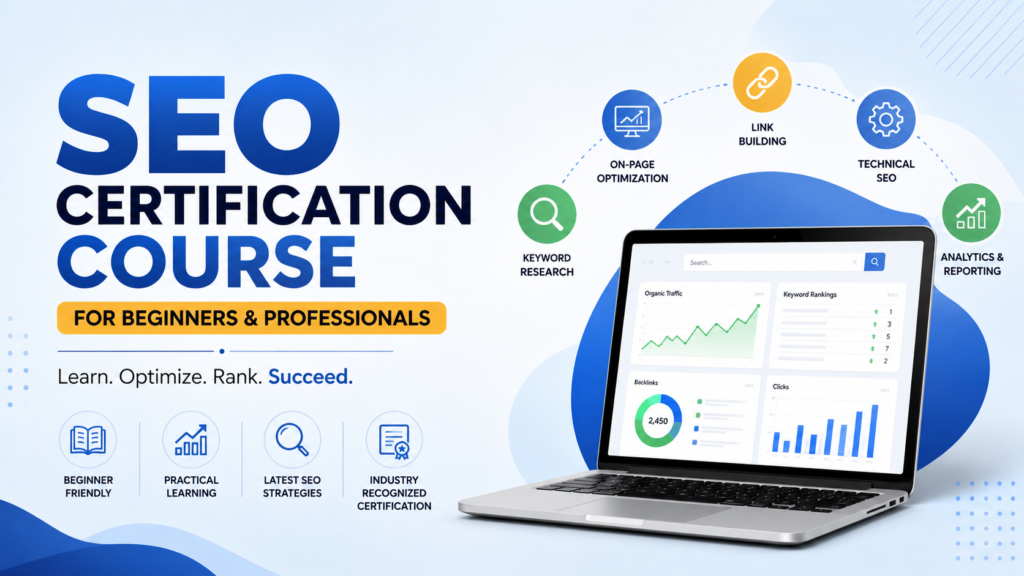
Introduction
Search Engine Optimization (SEO) has become one of the most valuable digital skills in today’s competitive online marketplace. Whether you are a student planning your career, a housewife looking for flexible work opportunities, a business owner aiming to increase online visibility, or a working professional seeking career growth, learning SEO can open doors to countless opportunities.
Every day, millions of people use search engines to find products, services, and information. Businesses compete to appear on the first page of search results because higher rankings often lead to more website traffic, better brand visibility, and increased sales. This growing demand has created a significant need for skilled SEO professionals across industries.
Unlike many traditional careers, SEO offers diverse opportunities, including full-time jobs, freelancing, consulting, and entrepreneurship. As businesses continue investing in digital marketing, companies actively seek professionals who understand how search engines work and can improve website performance.
Completing an SEO Certification Course not only helps you learn industry-relevant skills but also demonstrates your commitment and expertise to employers and clients. A structured learning program provides hands-on experience with real projects, modern SEO tools, and practical strategies that go beyond theoretical concepts.
If you’re exploring Digital Marketing Courses in Mumbai, choosing a program that includes comprehensive SEO training can significantly improve your career prospects. Many professional courses now integrate artificial intelligence (AI), analytics, automation, and real-world case studies to prepare learners for the evolving digital landscape.
This guide explains everything you need to know about SEO certification, who should enroll, the skills you’ll learn, career opportunities, and how AI is transforming modern SEO practices.
What is an SEO Certification Course?
An SEO Certification Course is a structured training program designed to teach individuals how to optimize websites for search engines like Google. The primary objective is to help websites achieve higher rankings in search results, increase organic traffic, and generate more qualified leads.
Unlike free tutorials that often cover isolated topics, a professional certification course follows a structured curriculum, allowing learners to build a strong foundation before advancing to more complex SEO strategies.
What Will You Learn?
A comprehensive SEO course typically covers:
- Keyword Research
- Search Intent Analysis
- On-Page SEO
- Technical SEO
- Off-Page SEO
- Link Building
- Local SEO
- E-commerce SEO
- SEO Audits
- Google Search Console
- Google Analytics
- AI-powered SEO
- Competitor Research
- Content Optimization
- Schema Markup
- Core Web Vitals
These topics help learners understand both the technical and strategic aspects of search engine optimization.
Benefits of an SEO Certification Course
A structured SEO program offers several advantages:
Practical Learning
Instead of only reading theory, students work on live websites, perform keyword research, and optimize real pages.
Industry-Recognized Skills
Certification demonstrates your ability to apply SEO best practices, making your profile more attractive to employers and clients.
Career Opportunities
SEO professionals are in demand across:
- Digital Marketing Agencies
- IT Companies
- E-commerce Businesses
- Startups
- Corporate Organizations
- Freelancing Platforms
Confidence with SEO Tools
Students gain hands-on experience using popular tools such as:
- Google Search Console
- Google Analytics
- Ahrefs
- SEMrush
- Screaming Frog
- ChatGPT
- Google Keyword Planner
Who Should Join?
An SEO Certification Course is suitable for:
- College students
- Graduates
- Housewives
- Entrepreneurs
- Freelancers
- Bloggers
- Content Writers
- Small Business Owners
- Marketing Professionals
- Career Switchers
Regardless of your background, SEO is a skill that can be learned with consistent practice and guidance.
Free Learning vs Structured SEO Course
| Free Resources | Structured SEO Certification Course |
|---|---|
| Random tutorials | Step-by-step learning path |
| No mentor support | Expert guidance |
| Limited practical exposure | Live projects and assignments |
| No certification | Industry-recognized certificate |
| Outdated information | Updated according to Google’s latest algorithms |
| Self-learning challenges | Personalized doubt-solving sessions |
Although free resources are valuable for beginners, structured courses provide practical experience, accountability, and industry-relevant training.
If you’re comparing Digital Marketing Courses in Mumbai, prioritize programs that combine theoretical concepts with live implementation and real business case studies.
Who Should Join an SEO Certification Course?
One of SEO’s biggest advantages is its accessibility. Unlike many technical careers, SEO does not require an engineering degree or coding expertise. People from various educational and professional backgrounds can build successful careers by learning SEO.
Students
Students can gain valuable skills before graduation, increasing their employability and opening doors to internships, freelance projects, and full-time digital marketing roles.
Benefits include:
- Improved job readiness
- Practical experience
- Better placement opportunities
- Additional income through freelancing
Housewives
SEO offers flexible work arrangements, making it an excellent option for housewives seeking remote work or home-based income.
They can:
- Start freelancing
- Manage websites
- Work with local businesses
- Launch online businesses
- Build blogging careers
SEO requires only a laptop, internet connection, and continuous learning.
Business Owners
Business owners often rely heavily on paid advertising, which can become expensive over time. Learning SEO enables them to generate sustainable organic traffic and reduce dependence on paid campaigns.
Business owners can use SEO to:
- Increase website visitors
- Generate qualified leads
- Improve local visibility
- Build brand authority
- Lower customer acquisition costs
For entrepreneurs evaluating Digital Marketing Courses in Mumbai, SEO training can become a long-term investment in business growth.
Freelancers
SEO is among the most sought-after freelance services globally.
Freelancers can offer:
- Website SEO Audits
- Keyword Research
- On-Page Optimization
- Technical SEO
- Content Optimization
- Local SEO
- SEO Consulting
As expertise grows, freelancers can work with clients across industries and countries.
Working Professionals
Professionals in marketing, sales, content writing, web development, and business management can enhance their career prospects by adding SEO skills to their portfolios.
SEO knowledge improves:
- Career advancement
- Salary growth
- Cross-functional collaboration
- Leadership opportunities
Career Switchers
Many professionals transition from traditional industries into digital marketing because of the industry’s rapid growth.
SEO offers:
- Relatively low entry barriers
- High learning potential
- Flexible career options
- Continuous demand
Small Business Owners
Small businesses often compete with larger brands on limited budgets.
SEO enables them to:
- Reach local customers
- Improve Google rankings
- Increase website traffic
- Build trust
- Generate consistent leads without relying solely on paid advertising
Why is SEO One of the Most In-Demand Digital Marketing Skills?
As consumers increasingly rely on search engines to make purchasing decisions, businesses recognize the importance of ranking prominently in search results. This shift has made SEO one of the fastest-growing skills in digital marketing.
Rising Industry Demand
Organizations across sectors—including healthcare, education, e-commerce, finance, and technology—are investing in SEO to attract organic traffic and reduce advertising costs. This has created a strong demand for skilled professionals who can develop and execute effective SEO strategies.
Expanding Career Opportunities
SEO expertise opens doors to a variety of roles, such as:
- SEO Executive
- SEO Specialist
- SEO Analyst
- Technical SEO Expert
- Content Strategist
- Digital Marketing Executive
- SEO Consultant
Professionals can work in agencies, startups, multinational companies, or as independent consultants.
Remote Work and Freelancing
SEO is well-suited for remote work. Many businesses hire SEO specialists to manage projects from anywhere, making it an attractive career for those seeking flexibility.
Freelancers can build long-term client relationships and work across different industries without geographical limitations.
Supporting Business Growth
SEO is not just about rankings—it contributes directly to business outcomes by:
- Increasing website visibility
- Driving targeted traffic
- Enhancing user experience
- Building brand credibility
- Improving conversion opportunities
These benefits make SEO a strategic investment for organizations of all sizes.
Why Practical Training Matters
While foundational knowledge is important, SEO success depends on applying concepts to real websites, analyzing data, and adapting to search engine updates. Practical experience helps learners develop problem-solving skills and confidence.
Many learners exploring Digital Marketing Courses in Mumbai look for programs that combine theory with hands-on projects, ensuring they are prepared for real-world challenges.
What Will You Learn in an SEO Certification Course?
A well-structured SEO Certification Course equips learners with the skills needed to improve a website’s visibility on search engines like Google. Modern SEO is no longer limited to adding keywords to web pages. It combines technical knowledge, content strategy, user experience, analytics, and artificial intelligence (AI) to help websites rank higher and attract the right audience.
If you’re comparing Digital Marketing Courses in Mumbai, choose a program that offers practical training, live projects, and the latest AI-powered SEO techniques. Below are the core modules you should expect in a comprehensive SEO certification course.
1. Keyword Research
Keyword research is the foundation of every successful SEO strategy. It involves identifying the words and phrases your target audience uses when searching online.
In this module, you’ll learn how to:
- Find high-search-volume keywords
- Identify long-tail keywords with lower competition
- Understand search intent
- Analyze keyword difficulty
- Build keyword clusters for better content planning
Popular Tools Covered
- Google Keyword Planner
- Google Trends
- Ahrefs
- SEMrush
- Ubersuggest
Example
Instead of targeting a broad keyword like SEO, you might optimize for SEO Certification Course for Beginners or Digital Marketing Courses in Mumbai, which are more specific and often easier to rank for.
2. On-Page SEO
On-page SEO focuses on optimizing individual web pages so search engines can understand their content and users can have a better experience.
You’ll learn how to optimize:
- SEO Titles
- Meta Descriptions
- URL Structure
- Heading Tags (H1-H6)
- Internal Links
- Image Alt Text
- Keyword Placement
- Content Readability
- Anchor Text
- Featured Snippets
Best Practices
✔ Write compelling meta titles.
✔ Use descriptive headings.
✔ Include keywords naturally.
✔ Optimize images for speed.
✔ Improve user experience.
On-page SEO is often the first skill learners master because it directly impacts rankings and website performance.
3. Technical SEO
Even high-quality content may struggle to rank if a website has technical issues. Technical SEO ensures that search engines can crawl, index, and understand your website effectively.
Topics Covered
- Website Crawling
- Indexing
- XML Sitemap
- Robots.txt
- HTTPS Security
- Canonical Tags
- Crawl Budget
- Duplicate Content
- Broken Links
- Website Speed
- Mobile Optimization
Why It Matters
A technically sound website provides a better experience for both users and search engines, improving visibility and ranking potential.
4. Off-Page SEO
Off-page SEO refers to activities performed outside your website to improve authority and trustworthiness.
Key Concepts
- Link Building
- Guest Posting
- Brand Mentions
- Digital PR
- Social Signals
- Influencer Outreach
- Citation Building
Quality Over Quantity
A few backlinks from reputable websites are generally more valuable than many links from low-quality sources. Understanding ethical link-building practices helps create sustainable SEO results.
5. Local SEO
Local SEO helps businesses appear in search results for location-based queries, making it especially valuable for small businesses and service providers.
You’ll Learn
- Google Business Profile Optimization
- Local Keyword Research
- Local Citations
- Customer Reviews
- Google Maps Optimization
- NAP Consistency (Name, Address, Phone Number)
Example
A bakery in Mumbai can optimize for searches like best bakery near me or birthday cake shop in Mumbai to attract nearby customers.
For many businesses offering Digital Marketing Courses in Mumbai, Local SEO plays a significant role in reaching students searching within the city.
6. E-commerce SEO
E-commerce websites often have hundreds or thousands of product pages. SEO helps these pages become discoverable through search engines.
Topics Covered
- Product Page Optimization
- Category Page SEO
- Product Schema
- Internal Linking
- Product Reviews
- Duplicate Product Content
- Faceted Navigation
Good e-commerce SEO can improve organic traffic and increase online sales without relying solely on paid advertising.
7. SEO Audits
An SEO audit identifies issues that may prevent a website from performing well in search results.
You’ll Learn to Analyze
- Website Health
- Technical Errors
- Missing Metadata
- Slow Loading Pages
- Broken Links
- Thin Content
- Duplicate Content
- Crawl Errors
- Mobile Usability
SEO professionals use audits to create action plans that improve website performance over time.
8. Google Search Console
Google Search Console is one of the most important free tools for SEO professionals.
You’ll Learn How To
- Monitor website performance
- Track keyword rankings
- Identify indexing issues
- Submit XML sitemaps
- Fix crawl errors
- Improve Core Web Vitals
- Analyze click-through rates (CTR)
Understanding Search Console helps you make data-driven decisions rather than relying on assumptions.
9. Google Analytics
Google Analytics provides insights into how users interact with your website.
Key Metrics Covered
- Website Traffic
- User Behavior
- Traffic Sources
- Bounce Rate
- Session Duration
- Conversion Tracking
- Goal Setup
These insights help businesses understand what is working and where improvements are needed.
10. Competitor Analysis
Successful SEO strategies often begin by understanding what competitors are doing well.
You’ll Learn
- Competitor Keyword Analysis
- Backlink Research
- Content Gap Analysis
- Traffic Estimation
- Ranking Opportunities
- Content Benchmarking
Analyzing competitors helps identify opportunities to create better content and improve rankings.
11. AI for SEO
Artificial Intelligence is transforming how SEO professionals work. Instead of replacing SEO, AI helps automate repetitive tasks, generate ideas, and improve efficiency.
AI Applications Include
- Content Brief Creation
- Keyword Clustering
- Meta Description Generation
- Content Optimization
- Search Intent Analysis
- Competitor Research
- SERP Analysis
Modern Digital Marketing Courses in Mumbai increasingly include AI modules to prepare learners for the future of digital marketing.
12. Prompt Engineering for SEO
Prompt engineering is the skill of writing effective instructions for AI tools to generate accurate and useful outputs.
Example Prompts
- Generate 50 long-tail keywords for a bakery.
- Create SEO-friendly meta titles.
- Suggest internal linking opportunities.
- Rewrite content for better readability.
- Generate FAQ ideas based on search intent.
Learning prompt engineering enables SEO professionals to save time while maintaining content quality.
13. SEO Automation
Automation helps reduce manual work and improve efficiency.
Common Automation Tasks
- Rank Tracking
- Site Audits
- Content Optimization
- Reporting
- Keyword Monitoring
- Competitor Tracking
- Broken Link Detection
Automation allows SEO teams to focus more on strategy and decision-making.
14. Schema Markup
Schema markup is structured data added to web pages to help search engines better understand content.
Types of Schema
- FAQ Schema
- Article Schema
- Product Schema
- Organization Schema
- Local Business Schema
- Review Schema
Proper schema implementation can improve the appearance of search results through rich snippets.
15. Core Web Vitals
Google considers user experience when ranking websites. Core Web Vitals measure how users experience page loading and interaction.
Metrics Include
- Largest Contentful Paint (LCP)
- Interaction to Next Paint (INP)
- Cumulative Layout Shift (CLS)
Improving these metrics contributes to better user satisfaction and can support SEO performance.
16. Site Architecture
A clear website structure helps both users and search engines navigate content efficiently.
Best Practices
- Logical URL Structure
- Simple Navigation
- Effective Internal Linking
- Organized Categories
- Breadcrumb Navigation
A well-planned site architecture improves crawlability and enhances the overall user experience.
Top AI Tools Every SEO Professional Should Learn
Artificial Intelligence has become an essential part of modern SEO workflows. While AI cannot replace strategic thinking or human creativity, it can significantly improve productivity by assisting with research, analysis, and content optimization.
Here are some of the most useful AI tools for SEO professionals.
1. ChatGPT
ChatGPT helps with a wide range of SEO tasks, including:
- Keyword brainstorming
- Blog outlines
- Content optimization
- Meta title suggestions
- FAQ generation
- Content rewriting
- Internal linking ideas
Practical Use Case
Create an SEO-friendly blog outline targeting SEO Certification Course with supporting H2 headings based on user search intent.
2. Gemini
Gemini can assist with:
- Search intent analysis
- Content planning
- Summarizing complex topics
- Research support
- Data interpretation
Practical Use Case
Analyze the top-ranking pages for a target keyword and identify common themes to include in your content.
3. Claude
Claude is particularly useful for working with long-form content.
It helps with:
- Editing lengthy articles
- Improving readability
- Maintaining consistent tone
- Content expansion
- Summarization
Practical Use Case
Review a 3,000-word blog to identify gaps, improve structure, and enhance clarity.
4. Perplexity
Perplexity combines AI-generated responses with cited sources, making it valuable for research.
Use Cases
- Finding current SEO trends
- Gathering supporting statistics
- Understanding algorithm updates
- Exploring industry insights
5. Surfer SEO
Surfer SEO analyzes top-ranking pages and provides recommendations for content optimization.
Features
- Content Score
- Keyword Suggestions
- Heading Recommendations
- NLP Terms
- Internal Linking Insights
Practical Use Case
Optimize an article by comparing it against top-ranking competitors for better topical relevance.
6. Frase
Frase streamlines the content creation process by generating briefs and identifying commonly asked questions.
It Helps With
- Content Briefs
- SERP Analysis
- Question Research
- Topic Coverage
- Outline Generation
This is especially useful when creating informational blogs that align with user search intent.
7. Semrush AI
Semrush combines traditional SEO data with AI-powered recommendations.
Key Features
- Keyword Research
- Site Audits
- Competitor Analysis
- Position Tracking
- Content Recommendations
Practical Use Case
Identify keyword gaps and uncover opportunities to improve existing content.
8. Ahrefs AI
Ahrefs offers powerful tools for backlink analysis, keyword research, and content exploration.
Benefits
- Backlink Insights
- Content Gap Analysis
- Keyword Opportunities
- Site Health Monitoring
- SERP Tracking
9. NeuronWriter
NeuronWriter uses natural language processing (NLP) to help writers create content that is both user-friendly and search-engine optimized.
It Supports
- Semantic Keyword Suggestions
- Readability Improvements
- Content Scoring
- Topic Optimization
- NLP-Based Recommendations
Practical Use Case
Enhance an article by incorporating related terms and improving topical coverage without overusing keywords.
Frequently Asked Questions (FAQs)
1. Is an SEO Certification Course worth it in 2026?
Yes. SEO continues to be one of the most in-demand digital marketing skills as businesses focus on increasing organic traffic and reducing advertising costs. A structured SEO Certification Course provides practical knowledge, industry-recognized credentials, and hands-on experience that can improve your career prospects.
2. Can I learn SEO without coding?
Absolutely. Most SEO tasks do not require programming skills. While understanding basic HTML can be helpful, beginners can successfully learn keyword research, content optimization, on-page SEO, local SEO, and link building without any coding knowledge.
3. How long does it take to learn SEO?
The learning timeline depends on your goals and practice. Most learners understand SEO fundamentals within 2–3 months, while becoming proficient may take 6–12 months of consistent practice on real websites and projects.
4. Is SEO a good career option?
Yes. SEO offers diverse career opportunities, including roles such as SEO Executive, SEO Analyst, SEO Specialist, Digital Marketing Executive, SEO Consultant, and Content Strategist. It also provides freelancing and remote work opportunities for professionals worldwide.
5. Can housewives build a career in SEO?
Yes. SEO is a flexible profession that can be learned and practiced from home. Many housewives work as freelance SEO professionals, bloggers, or digital marketing consultants, allowing them to balance work with personal responsibilities.
6. Can business owners benefit from learning SEO?
Definitely. Business owners who understand SEO can improve their website’s visibility, attract qualified leads, reduce dependency on paid advertising, and build a stronger online presence for long-term business growth.
7. What is the average salary after completing an SEO Certification Course?
Salaries vary depending on experience, location, and skill level. Entry-level SEO professionals can expect competitive starting salaries, while experienced specialists, consultants, and managers often earn significantly more. Freelancers and agency owners have the potential to increase their earnings by working with multiple clients.
8. Which is better: an SEO Certification Course or a Digital Marketing Course?
If your goal is to specialize in search engine optimization, an SEO Certification Course is an excellent choice. However, if you want to develop broader skills in social media marketing, PPC, email marketing, content marketing, analytics, and SEO, a comprehensive digital marketing course may be more suitable.
9. Will AI replace SEO professionals?
No. AI is transforming the way SEO professionals work by automating repetitive tasks, assisting with research, and improving productivity. However, human expertise is still essential for strategy, creativity, decision-making, and understanding user intent.
10. Does DGmark Institute offer practical SEO training?
Yes. DGmark Institute provides practical SEO training that focuses on live projects, hands-on implementation, industry-relevant tools, and real-world case studies. Learners gain experience applying SEO techniques rather than only studying theoretical concepts.
Conclusion
Search Engine Optimization is no longer just a valuable skill—it has become an essential part of modern digital marketing. As businesses continue investing in their online presence, the demand for skilled SEO professionals continues to grow across industries.
Whether you’re a student preparing for your first job, a housewife looking for flexible work opportunities, a freelancer aiming to expand your services, or a business owner seeking sustainable online growth, learning SEO can provide long-term benefits. A structured SEO Certification Course equips you with practical skills in keyword research, technical SEO, content optimization, analytics, local SEO, and AI-powered SEO strategies.
If you’re exploring Digital Marketing Courses in Mumbai, choose a learning program that emphasizes hands-on training, live projects, updated AI modules, experienced mentors, and industry-relevant certifications. Practical experience not only builds confidence but also prepares you to solve real business challenges.
The digital landscape continues to evolve, and search engine algorithms change regularly. Continuous learning, practical implementation, and staying updated with industry trends are the keys to long-term success in SEO.
If you’re ready to build future-ready digital marketing skills, explore DGmark Institute’s practical training programs to gain the knowledge and confidence needed to succeed in today’s competitive digital world.